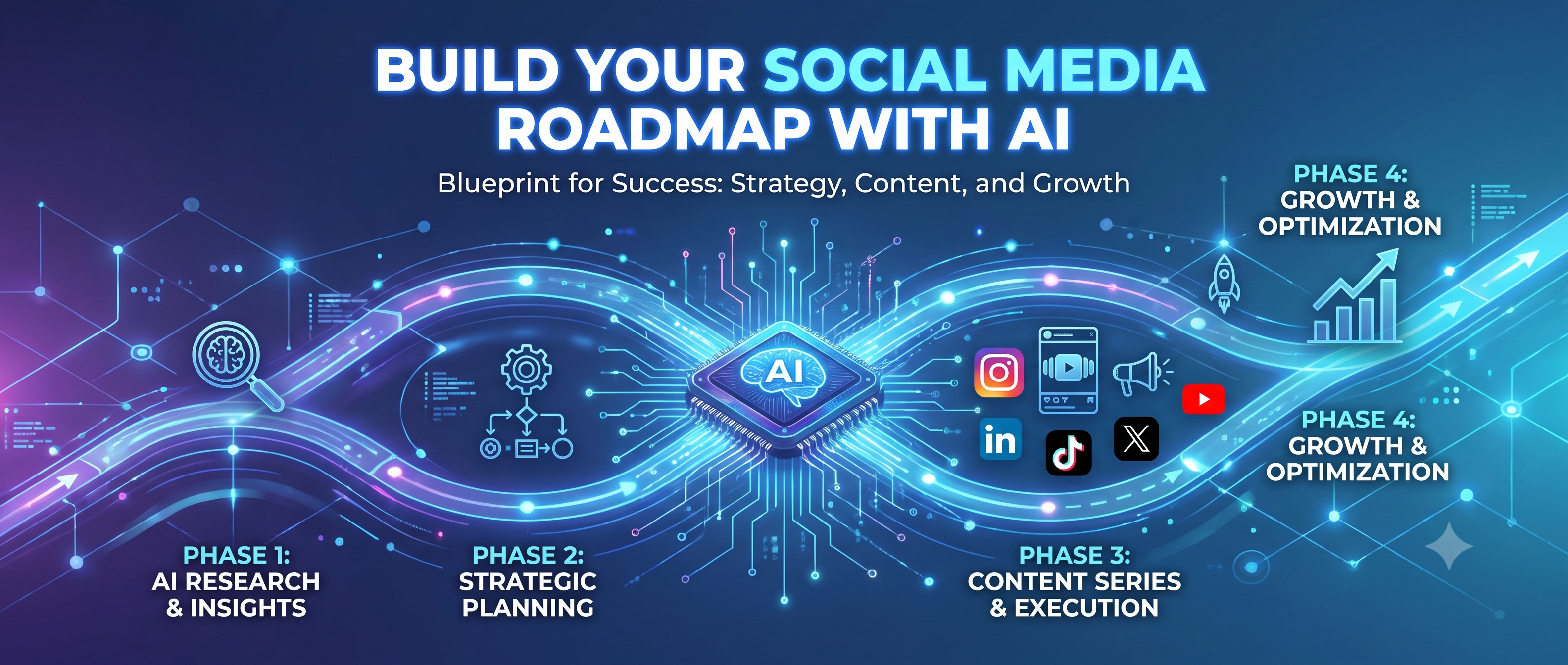
Managing social media for a business can often feel like trying to assembly furniture without the instruction manual. You have all the individual pieces—creative ideas, product photography, platform accounts, and graphic assets—but without a structured, long-term plan, the final structure rarely holds up.
A Social Media Roadmap is that essential instruction manual. It outlines your overarching goals, content themes, visual directions, and execution timelines over a multi-month period.
Traditionally, building a comprehensive roadmap required endless brainstorming sessions, intensive market data mining, and countless formatting hours. Today, artificial intelligence has evolved into an agentic strategy partner. Here is a detailed breakdown of how you can use AI to build a scalable, highly effective social media roadmap from scratch.
---
What is a Social Media Roadmap?
Unlike a basic content calendar—which simply tells you what to post on Tuesday at 9 AM—a Social Media Roadmap is a high-level strategic document. It acts as a bridge between your core business objectives and your day-to-day execution.
A comprehensive roadmap typically includes:
* Strategic Phases: Clear thematic periods (e.g., Phase 1: Brand Awareness & Discovery, Phase 2: Community Trust, Phase 3: Launch & Conversion). * Platform Specialization: Defining unique roles for each network (e.g., Instagram for raw storytelling and discovery, LinkedIn for thought leadership, TikTok for trends). * Asset & Visual Guidelines: Unified design languages, recurring content series, and brand design elements. * Key Performance Indicators (KPIs): Data-backed benchmarks to measure success at every milestone.
---
Step-by-Step: Building Your Roadmap with AI
AI tools can act as your researcher, data analyst, copywriter, and project manager all at once. By following this collaborative workflow, you can generate a master roadmap in a fraction of the time.
Step 1: Extracting Deep Insights and "Gaps"
Before plotting dates on a timeline, you need data. Advanced AI tools can analyze massive amounts of competitive and internal data to find out what actually works in your specific industry.
* The AI Prompt Strategy: Ask an advanced AI engine to review your top three competitors’ public profiles alongside your own past campaign briefs. * The Output: The AI will instantly synthesize core audience pain points, identify content formats that get the highest save/share rates, and flag "content gaps" that your competitors are completely missing.
Step 2: Defining the Strategic Phases
A great roadmap doesn't launch everything at once. It builds momentum. You can use generative AI to map out your strategic campaign progression.
* How AI Helps: By feeding the AI your core quarterly business goals, it can break down your timeline into logical, chronological phases. For instance, if you are planning a massive product launch in 90 days, the AI can structure a roadmap that dedicates Weeks 1-4 to heavy educational awareness, Weeks 5-8 to interactive community teasing and user-generated content, and Weeks 9-12 to hard conversion-focused video assets.
Step 3: Architecting Repeatable Content Series
The secret to sustainable social media consistency is creating structured, repeatable content franchises (e.g., a weekly "Myth-Busting Monday" reel or a Thursday carousel deep-dive).
* How AI Helps: Based on the strategic phases generated in Step 2, you can task AI with developing 3 to 4 distinct "content pillars." The AI can map out exactly how a single core idea can be structurally reframed across multiple formats—turning a single technical breakdown into a vertical video script, an infographic layout, and an optimized text caption tailored to search intent.
Step 4: Setting Realistic, Data-Backed Benchmarks
Guessing your social media growth goals usually leads to missed targets or underperforming campaigns.
* How AI Helps: AI data platforms can process current industry benchmarks and historical data to forecast achievable metrics. It can generate specific target KPIs for each phase of your roadmap—such as target engagement rates, retention times for short-form video, and conversion benchmarks—giving your team definitive, realistic goals to aim for.
---
Bringing the Visual Elements into Focus
A roadmap is a living blueprint, meaning it needs to be easily understood at a glance by your creative teams, stakeholders, or external partners.
[ AI Deep Research ] ➔ [ Timeline Phase Generation ] ➔ [ Visual Series Scripting ] ➔ [ Dashboard Export ]
Once the AI assists you in defining the theoretical and textual strategy, you can port the data directly into visual production dashboards like Canvas or Google Docs. This allows your graphic designers and video editors to view the exact visual references, asset requirements, and scheduling goals mapped out for the upcoming months.
---
Balancing AI Blueprinting with Human Directives
While AI is incredibly efficient at structuring timelines, generating layout options, and analyzing macro data, it lacks human intuition.
The most successful social media roadmaps use AI as a foundational framework. It is up to you to infuse the roadmap with real-world context, local nuances, brand voice adjustments, and genuine community-building elements. By letting AI build the skeleton of your strategy, you save your energy for the creative execution that truly makes a brand stand out online.