If you’ve ever launched a Facebook ad campaign and watched your ad spend vanish with little to show for it, you’re not alone. Far too often, advertisers treat paid ads like a magic button: set up a quick campaign, target a broad audience, throw in a single image with a "Buy Now" button, and hope for the best.
When it doesn't convert, the blame usually falls on the ad platform or rising CPMs. But the real culprit is almost always context.
Paid ads don't exist in a vacuum. A user who sees your ad on Facebook will likely click through to your organic page, scroll through your recent feed, and evaluate your brand's overall presence before deciding to trust you.
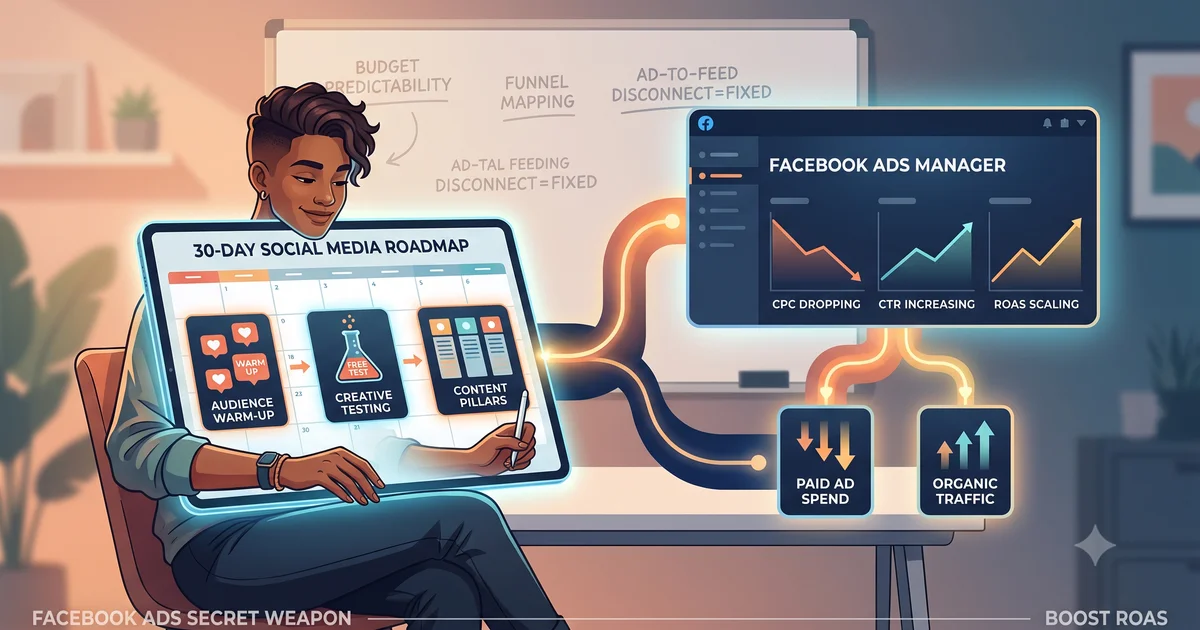
This is where a 30-day social media roadmap changes everything. By aligning your organic strategy with your paid advertising, a monthly roadmap turns disjointed ad spending into a cohesive, high-converting growth engine. Here is how a 30-day roadmap transforms your Facebook Ads performance.
---
1. It Builds Warm Audiences Before You Spend a Dime on Conversion Ads
Cold traffic is expensive. Running conversion-focused ads directly to people who have never heard of your business often leads to low click-through rates (CTR) and high Customer Acquisition Costs (CAC).
A 30-day roadmap allows you to plan a staged audience warm-up across your calendar:
* Weeks 1 & 2 (Organic Warm-Up): Post high-value, problem-aware organic content (educational Reels, carousel guides, founder stories) anchored in your core content pillars. * Week 3 (Retargeting Boost): Launch low-cost engagement ads boosting your top-performing organic video or post to expand your custom audiences. * Week 4 (High-Intent Conversion): Run direct response conversion ads specifically to people who engaged with your organic posts or video views over the past 21 days.
By using your 30-day roadmap to nurture organic touchpoints first, your conversion ads hit a warm, familiar audience that is primed to take action—significantly lowering your cost per lead or sale.
---
2. Organic Posts Act as Your Free Creative Testing Ground
One of the largest drains on a Facebook ad budget is testing ad creative. Testing dozens of hooks, copy variations, and visuals directly inside Meta Ad Manager gets expensive fast.
When you operate with a 30-day roadmap, your organic feed becomes your zero-cost creative laboratory:
[ Step 1: Post 10–12 Organic Formats ] ➔ [ Step 2: Identify Top 20% Performance ] ➔ [ Step 3: Turn Organic Winners into Paid Creatives ]
During your end-of-month review, look closely at your organic analytics:
* Which hook held viewer attention past the 3-second mark on Reels? * Which topic drove the highest save-to-like ratio or comment volume?
Take the top-performing organic assets, add a direct Call-To-Action (CTA), and import them into Meta Ad Manager. You are no longer guessing what creative might work—you're putting ad dollars behind proven winners.
---
3. It Prevents "Ad-to-Feed Disconnect" (The Trust Gap)
Imagine clicking a compelling Facebook ad for a local service or high-end product, only to visit their Facebook Page and discover their last post was six months ago.
That immediate friction kills conversions. Modern consumers conduct micro-audits: when an ad catches their attention, they often tap the page profile to verify legitimacy.
A 30-day roadmap guarantees that your organic feed mirrors your active ad campaigns:
| Campaign Phase | Paid Ad Creative | Organic Feed Support | | --- | --- | --- | | Awareness / Consideration | Highlight common customer pain points and introduce your solution. | Case studies, deep-dive educational carousels, behind-the-scenes founder stories. | | Promotional / Launch | Direct product showcase with a limited-time promo or strong CTA. | Client testimonials, FAQs addressing buying objections, live Q&As. |
When your paid message and organic content tell the same cohesive story, prospect trust increases, conversion friction drops, and your page authority rises.
---
4. It Maximize ROAS Through Strategic Retargeting Funnels
Facebook's algorithm relies heavily on signals. When your paid ads and 30-day organic roadmap share synchronized messaging, your pixel and Meta Custom Audiences work far more effectively.
With a structured 30-day plan, you can map specific retargeting funnels based on user behavior:
- Top of Funnel (ToFU): Organic educational posts introduce problem-solution dynamics.
- Middle of Funnel (MoFU): Facebook video ads target custom audiences built from users who interacted with those organic posts.
- Bottom of Funnel (BoFU): Dynamic product ads or direct offer ads target users who visited your website or clicked on previous campaign links.
Instead of running generic "Buy Now" ads to cold audiences 30 days a month, your roadmap orchestrates a smooth, logical journey that guides prospects naturally from discovery to purchase.
---
5. Better Resource Allocation and Budget Predictability
Running ads without a calendar often leads to reactive, panic-driven ad spend—boosting a random post at 9 PM because sales felt slow that week.
A 30-day roadmap brings predictability to both your creative workflow and your financial plan:
* Clear Content Batching: Script, shoot, and design both your organic assets and paid ad creatives in dedicated production blocks. * Synchronized Budgets: Allocate your ad spend to match your promotional roadmap milestones (e.g., spending 20% on awareness during Week 1, and shifting 80% to conversions during Week 4). * Clear KPI Alignment: Track macro-metrics (Overall ROI, CAC, Lead Quality) across the entire 30 days rather than obsessing over day-to-day CPM fluctuations.
---
The Takeaway: Paid and Organic Are Two Sides of the Same Coin
Your Facebook Ads shouldn't be an isolated experiment; they should be the amplified extension of a well-oiled organic strategy.
A 30-day social media roadmap gives your paid campaigns context, proven creative, warm audiences, and an authentic brand presence to back them up. Stop burning ad budget on cold traffic—map out your next 30 days, align your messaging, and watch your ad returns scale predictably.